

For centuries, stolen artworks had an unnerving habit of simply disappearing. Once a painting or antiquity slipped into the shadows of the art market, it could remain lost for decades.
Artificial intelligence may be changing that.
Developed by Italy’s Carabinieri Command for the Protection of Cultural Heritage (Comando Carabinieri per la Tutela del Patrimonio Culturale, or “TPC”), the S.W.O.A.D.S. system uses artificial intelligence to search the internet for stolen artworks and cultural objects.
The system scans online auction platforms, catalogues, social media, open-source marketplaces and even the “dark web”, comparing images and descriptions against Italy’s vast national database of stolen cultural property. That database contains records relating to more than 7 million cultural objects. When the system identifies a possible match, trained officers review the alert and decide whether further investigation is needed.
At a moment when artificial intelligence is generally presented either as the harbinger of civilisation’s collapse or as a machine designed to write disappointing emails faster, it is encouraging to see it deployed in defence of cultural property.
The idea of an AI investigator sounds wonderfully futuristic, but also strangely inevitable. Cultural crime has become global, fast and technologically fluent. Italy’s response has been to build a detective capable of reading the entire internet without ever sleeping.
And it works.
In less than two years, the S.W.O.A.D.S. initiative has contributed to the recovery of more than 200 stolen objects. In 2023 alone, according to TPC commander Vincenzo Gargaro, the initiative helped identify and confiscate more than 105,000 cultural objects worth over €264 million worldwide.
Some of the recoveries have been remarkable precisely because they seemed impossible.
Among them was Riposo della pastorella, a painting by Filippo Palizzi stolen in 1972 from the Carlo Rizzarda Gallery in Feltre. For more than fifty years, the work had effectively disappeared. S.W.O.A.D.S. identified it in a Piedmont auction house after matching the image against records in the national database. The artwork was seized and eventually returned to the museum in Feltre after further authentication.
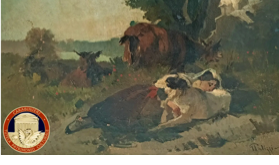
Another recovery involved Padre Eterno, a sixteenth-century Piedmontese painting stolen in the 1970s and rediscovered in an auction house in 2024.

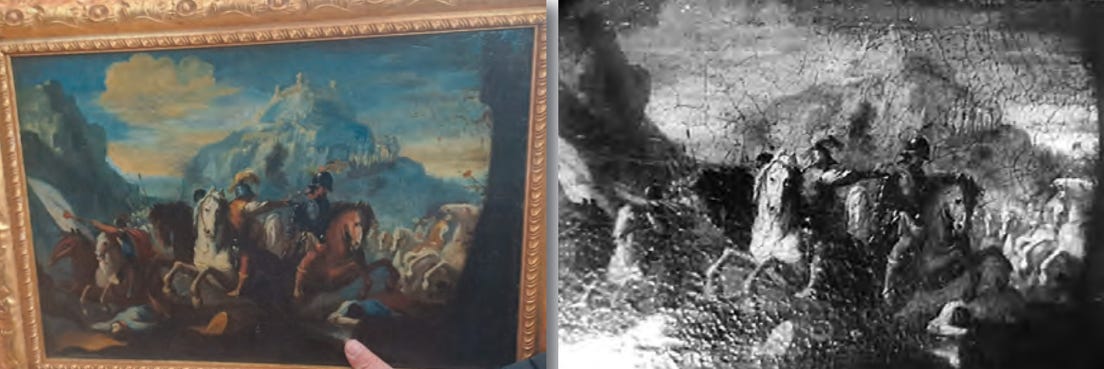
S.W.O.A.D.S. also helped locate Scontro di Cavalieri by Francesco Monti, stolen in Rome in 1992 and later found in a gallery near Brescia.
The larger story behind these recoveries is the changing nature of restitution itself. Historically, recoveries often depended on luck: a curator recognising an image in a catalogue, an academic noticing an inconsistency in provenance records, or Kim Kardashian inadvertently posing next to a looted Egyptian sarcophagus during the Met Gala (as absurd as that may sound, it is a true story). With AI, investigators can monitor thousands of listings continuously and simultaneously. The scale alone changes the game.
And the system is still developing.
SWOADS 2.0 is already underway with funding from the European Internal Security Fund (ISF), the European Union’s main financial instrument for supporting internal security, including tackling cross-border crime and terrorism.The next phase will expand search capabilities and introduce more advanced forms of recognition, including the automatic identification of objects appearing on ICOM “Red Lists”. The system will also analyse video footage frame by frame and be able to recognize three-dimensional objects.
Perhaps the most ambitious development is SWOADSNet, which aims to connect law-enforcement agencies internationally so they can share and cross-reference cultural-property data directly.
Although certainly among the most ambitious initiatives currently underway, Italy is not alone in developing AI tools for cultural heritage protection.
Türkiye recently developed TraceART (as it is a specialised government tracking tool for internal and expert use, it does not have a consumer-facing website that the public can access) and France introduced Arte-Fact (Arte Fact – Let’s protect our cultural heritage together). Both are based on similar principles.
Taken together, these AI projects suggest that the balance of power in the art world may be shifting, however slightly, away from traffickers and towards investigators. For decades, the illicit trade in cultural objects thrived on slowness: slow communication between countries, slow cataloguing, slow recognition and the comforting assumption that a stolen object could simply dissolve into the vastness of the international art market. Projects like S.W.O.A.D.S. change the tempo entirely.
A painting stolen half a century ago can now be recognised in seconds. An antiquity photographed in a social-media video can trigger an investigation before it ever reaches an auction house. Somewhere, at this very moment, software is quietly comparing thousands of images against millions of records, searching for objects the world once assumed were lost for good.
Pierre Valentin, Patrick McGranaghan