
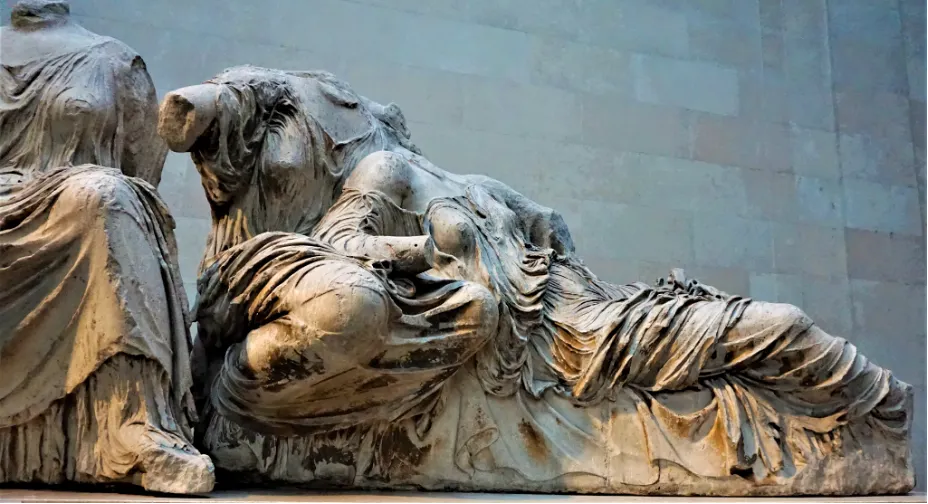
Parthenon Marbles this, Parthenon Marbles that. For the past few years, the debate has been relentless and inescapable. News headlines, diplomatic misfires, UNESCO interventions and a growing swell of international tension have all revolved around the same fragments of classical sculpture. And yet, despite the noise, the situation remains unchanged. Due to the British Museum Act 1963, the British Museum still cannot return the marbles, no matter how compelling the ethical case. For those hoping the law might finally budge, manage your expectations: nothing appears to be changing any time soon.
But while the Marbles remain legally and literally immobile, the landscape for certain other museums has quietly shifted.
In November 2025, changes introduced by the Charities Act 2022 came into force, making it easier for museums in England and Wales to authorize the return of objects from their collections on moral grounds. These reforms expand the powers of trustees to make what are known as “ex gratia” disposals of charity property. That is, disposals motivated by moral considerations and not, as is usually the case, to further their charitable purpose.
The route to this reform has been neither particularly visible nor rapid. The Charities Act 2022 received Royal Assent in February 2022, amending the Charities Act 2011, but its implementation was delayed whilst the government considered its potential implications for national institutions.
The reform is now fully operational. However, 16 museums have been specifically excluded from the scope of the new legislation. As detailed below, these museums may only rely on their governing statutes to dispose of any items in their collections.
Let’s see what has changed.
The Charities Act 2022: The Moral Standard.
Charities can only spend their funds and property on furthering their charitable purposes as set out in their governing document. But there may be times when trustees feel they have a moral obligation to:
● pay money out of the charity’s funds, or
● transfer charity property, or
● waive a right to money or property to which the charity is legally entitled, but has not yet received.
Before the 2022 reform of the Charities Act, trustees of charitable institutions already had a limited power to make ex gratia disposals. That power, however, was narrowly framed and always required external authorisation from the Charity Commission. Moreover, trustees were required to show that the decision underpinning the ex gratia decision was motivated by their personal moral obligations.
Sections 15 and 16 of the Charities Act 2022 clarify and extend the circumstances in which ex gratia disposals may be requested and authorised. Crucially, the legal test governing ex gratia decisions has shifted from a subjective to an objective standard.
Under the new rules, trustees are no longer required to demonstrate that they personally believe they are under a moral obligation to act. Instead, the test is whether the trustees could reasonably be regarded as being under a moral obligation to make the payment. This change is significant, as it removes the focus from individual conscience to an external, assessable standard.
Before these reforms came into effect, the ex gratia process had already been put to use multiple times. In 2021, for example, the Horniman Museum and Gardens sought and received approval to return their collection of Benin Bronzes to Nigeria. The Chair of Trustees described the move as rooted in the belief that it was “both moral and appropriate to return their ownership to Nigeria.” It was a powerful gesture, but one that relied on the trustees’ own sense of moral responsibility.
Under the new framework, decisions like this no longer need to depend entirely on personal views. Instead of asking whether the trustees themselves feel morally compelled, the law asks whether a reasonable person in their position would see a moral obligation to act.
The Charities Act 2022: More Autonomy.
The Charities Act 2022 also introduces specific financial thresholds under which trustees can now make ex gratia decisions without needing external consent. In practical terms, this means that trustees may return low-value items or make small ex gratia payments when a moral obligation can reasonably be said to exist, provided certain conditions are met.
To rely on this new power, three criteria must be satisfied: (1) the value of the payment or disposal must not exceed the relevant statutory threshold (see below); (2) trustees must have no other legal authority to make the payment except via the ex gratia powers; and (3) it must be reasonable to regard the trustees as being under a moral obligation to act.
The thresholds scale with the charity’s income in its most recent financial year:
● £1,000 for charities with income up to £25,000;
● £2,500 for income between £25,001 and £250,000;
● £10,000 for income between £250,001 and £1 million;
● £20,000 for income exceeding £1 million.
If the moral payment or transfer of property the trustees wish to make exceeds those amounts, the charity must apply to the Charity Commission for consent.
The maximum individual ex gratia payment means the total value in each case. The charity cannot split a moral payment to avoid applying to the Commission for authority.
Who does it not apply to?
The new ex gratia powers under the Charities Act 2022 only apply to certain museums in England and Wales.
While some originally thought the 2022 reforms might apply to all museums, this was officially ruled out in January 2024. In a letter that month, Lord Parkinson, then Minister for Heritage and the Arts, confirmed that 16 national museums were excluded. As a result, trustees at national museums cannot use the new powers to return items based on moral claims alone.
The 16 “excluded” museums are:
● The Royal Armouries
● The British Library
● The British Museum
● The Imperial War Museum
● The National Gallery
● The Natural History Museum
● The National Maritime Museum
● The National Museums and Galleries on Merseyside
● The National Portrait Gallery
● The Museum of London
● The Royal Botanic Gardens, Kew
● The Science Museum
● Sir John Soane’s Museum
● The Tate Gallery
● The Victoria and Albert Museum
● The Wallace Collection
These institutions are governed by Acts of Parliament that tightly control when and how objects can be removed from their collections. In order to return objects from their collections, they must rely on the provisions set out in these Acts. The British Museum Act 1963, for example, only allows disposals in a few cases, such as when an object is a duplicate, badly damaged, or unfit to be kept. Ethical or moral reasons are not considered valid grounds under this legislation.
This creates a split system. Non-national museums now have more flexibility to respond to ethical concerns, while national museums are still bound by older, more restrictive laws. This may lead to inconsistent outcomes when similar claims are made to different institutions.
Amid this uneven legal landscape, one point is clear: non-national museums now carry a greater moral burden. They have the tools to make decisions that reflect contemporary ethical standards. But with that power comes weightier judgment. Trustees must confront difficult questions about cultural ownership, historical accountability, and what justice looks like today.
While national museums remain constrained by law, it is non-national institutions that will determine the pace and direction of restitution in the UK. Their decisions will set the precedent. Their leadership will define what responsible stewardship means in the 21st century.
Pierre Valentin, Patrick McGranaghan and Aditii Kamath